The Great Extinction of the 21st Century
We all understand the importance of pollinators when it comes to growing crops, bees being one of the most important pollinators of the biosphere.
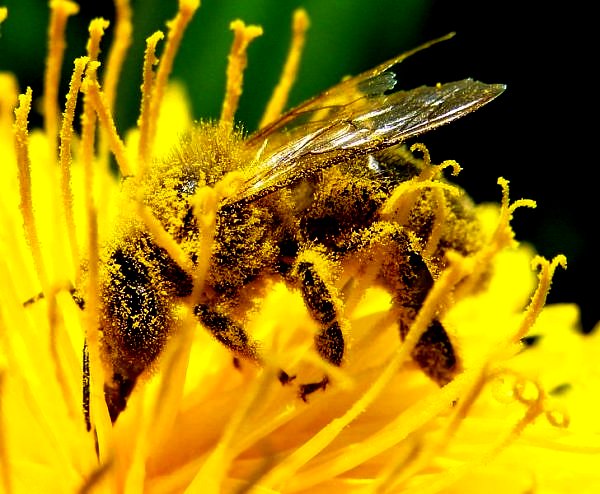
http://keepingbee.org/plants-for-bees/plants-for-bees2-2/
When attending a guest talk by Dr Paul Cross, senior lecturer of environmental sciences at Bangor university, the issue of pollinator loss became more apparent, and almost scary.
He highlighted the demand for more pristine, productive agricultural fields as a result of our ever-increasing population. By showing a comparison between crop fields in the 1950’s and 2010, the pristine nature of modern fields is overwhelmingly apparent.

https://www.theguardian.com/environment/2018/jan/31/stripes-of-wildflowers-across-farm-fields-could-cut-pesticide-spraying
But the change in landscape and absence of unwanted plants is not the issue.
Are modern pesticides actually safe?
Paul highlighted modern fields have become sterile as a result of 20,000 tonnes of neonicotinoids implemented globally to crops as a pesticide.
The 10-year testing period of these pesticides are wholly based on the LD50 for species in which may be at risk. However, it does not consider the secondary effects in which may increase the chance of mortality.

https://www.compoundchem.com/2015/04/14/neonicotinoids/
The appearance of Colony Collapse Disorder (CCD) has been highlighted as a mysterious phenomenon in which a colony of 50,000 healthy bees can inexplicably disappear in less than 12 hours.
It would be safe to presume that they may have been poisoned by pesticides used on local fields, however, this would have resulted in the presence of dead bees in and around the hive, in this case there is no dead bees present.
Where have all the bees gone!
In an attempt to find out what is going, Paul and his team of researchers and electronic engineers designed a unique tracking system consisting of harmonic radar tags placed on the thorax of bees then tracked using drones, as using standard radar systems highlighted the issue of range.

This unique system managed to identify the cause of CCD and ultimately highlighted a possible reason as to why there has been a 75% decline in flying insect biomass in the past 25 years.
It turns out that when bees are exposed to neonicotinoids, the section of the brain responsible for navigation becomes damaged, deeming the bee’s incapable of locating their hive. This explains the absence of dead bees in and around the hive.
The extinction of our crops
Ask yourself, what does this mean for the future of our crops?
Well, according to Paul all fruit and vegetables will be eliminated from our shelves, the derivatives associated with these foods will no longer be available.

http://ecstatictruthpdx.blogspot.com/2013/10/grocery-stores-without-bees.html
This begs the question ‘what can we do about this?’ Can we save the bees by changing legislation around the use and testing of pesticides? Do we blame the farmers for using such chemicals? Do we blame the chemists behind the development of such chemicals?
The truth is this is a cultural problem. With the ever-increasing demand for food, we have an ever-increasing demand for pest control over our crops. In my opinion the only way this can be changed is if we change the way we eat and the amount in which we eat it.

http://www.svgfit.com/2012_11_18_archive.html
What am I going to do?
As with most aspiring scientists, I want to make a difference, I want to change the world.
As humans we usually focus only on the large elegant creatures inhabiting our planet as a conservation priority, neglecting the importance of small invertebrates that stop this house of cards from collapsing.
This has personally provided a shift in mindset, highlighting how the smallest organisms are usually of the greatest importance.
Pauls research has taught me to never neglect the small things as it is usually the smallest entities that make the biggest difference.
This will no doubt affect my analytical methods throughout my career.
Thursday 17th October 2019
 Alex's Blog